The heater is the heart of any sauna. It decides how fast the room warms up, how evenly the heat spreads and how soft the steam feels. The short answer: choose a wood-burning heater if your sauna is outdoors, a chimney is possible and you want a real fire; choose an electric heater if you value convenience, precise temperature and no chimney. Size it by room volume — the general rule of thumb is roughly 1 kW per 1 m³.
Below we compare both types, show how to size the heater, explain why stones matter, what control panels do and which safety rules you should never skip.
Wood-burning vs electric sauna heater: the key differences
| Criterion | Wood-burning heater | Electric heater |
|---|---|---|
| Atmosphere | Live fire, scent of wood, traditional feel | Quiet, clean, even heat |
| Heating up | Stack wood, light it, tend the fire | Press a button, the thermostat does the rest |
| Temperature control | Approximate — by the amount of wood and draft | Precise — thermostat and timer |
| Installation needs | Chimney, fire-safe roof/ceiling pass-through, wood storage | Dedicated circuit and breaker, sometimes three-phase power |
| Best for | Country houses, gardens, out-of-town plots | Indoor saunas, apartments, hotels, spas |
| Maintenance | Ash removal, chimney checks | Checking stones and the sensor |
Who should choose a wood-burning heater?
- Anyone building a sauna in the garden, at a country house or outside the city who wants a classic bathhouse atmosphere.
- Locations where the electrical supply is weak or can’t handle a powerful heater.
- People who enjoy the ritual — splitting wood, lighting the fire, listening to it crackle.
Wood-burning heaters are especially popular in outdoor saunas: the chimney runs neatly through the roof, and the stove gives strong, “deep” heat even in a larger room.
Who should choose an electric heater?
- Indoor saunas — in a basement, next to a bathroom, inside a villa. No chimney is needed, so electric is the default choice for indoor builds.
- People who use the sauna often, for example for an hour after work.
- Hotels and spas, where stable temperature and timer control matter.
Sizing: heater kW vs room volume (m³)
The most common mistake is choosing heater output by guesswork. The calculation is simple:
- Find the room volume: width × length × height. Example: 2 m × 2 m × 2.1 m = 8.4 m³.
- Rule of thumb: for a well-insulated room, about 1 kW per 1 m³.
- Adjust for heat-hungry surfaces: each 1 m² of uninsulated surface — glass, tile, stone — adds roughly 1.2 m³ to the calculated volume. In a cabin sauna with a panoramic glass front, this makes a real difference.
- Check the manufacturer’s table: every heater’s manual states the room volume range it’s designed for. Make the final call based on that range.
| Room volume (approx.) | Suggested output (rule of thumb) |
|---|---|
| 4–6 m³ | 4.5–6 kW |
| 6–9 m³ | 6–9 kW |
| 9–13 m³ | 9–12 kW |
| 13 m³ and above | 12 kW and up, sometimes two heaters |
An undersized heater takes ages to warm the room and may never reach the target temperature. An oversized one cycles on and off constantly and makes the air dry and harsh. A correctly sized heater usually brings the room to a comfortable temperature in roughly 40–60 minutes, depending on insulation and outdoor weather.
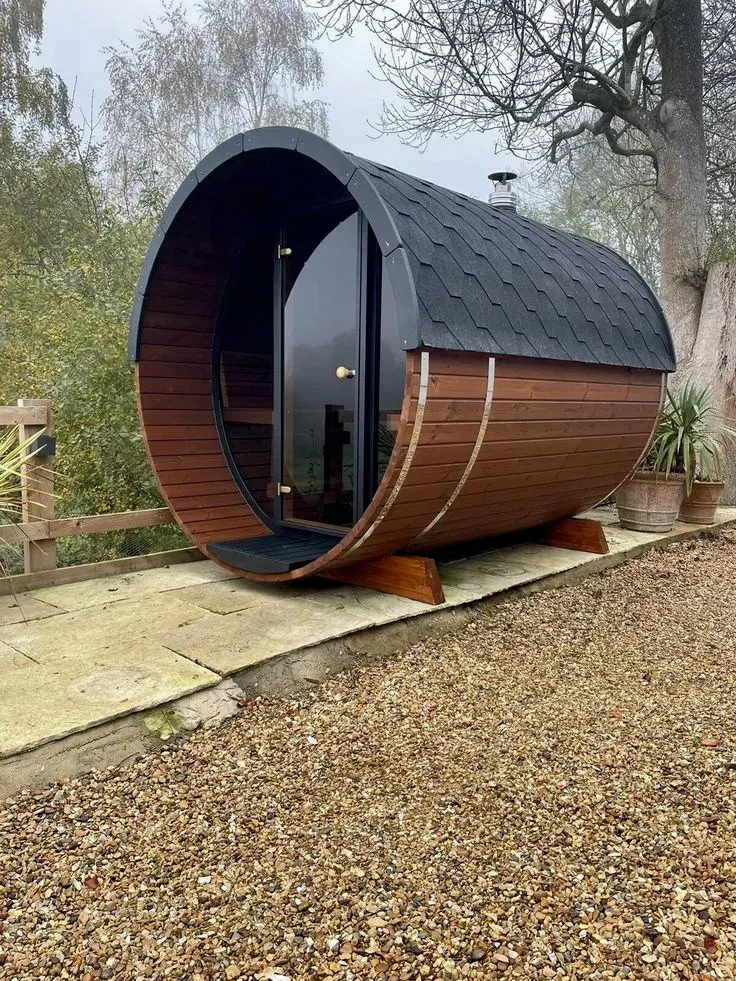
In a barrel sauna, the round shape means less air volume than a rectangular room of the same length, so the heater works more efficiently. Read more on our barrel sauna page.
Sauna stones: why they matter
Stones store the heater’s energy and release it gently into the room. The steam you get when you throw water on them — the Finns call it löyly — depends directly on stone quality.
- Use volcanic stones made specifically for saunas, such as olivine diabase or peridotite. They tolerate constant heating and cooling cycles.
- Don’t use river stones or random rocks — they can hold moisture inside and crack when heated.
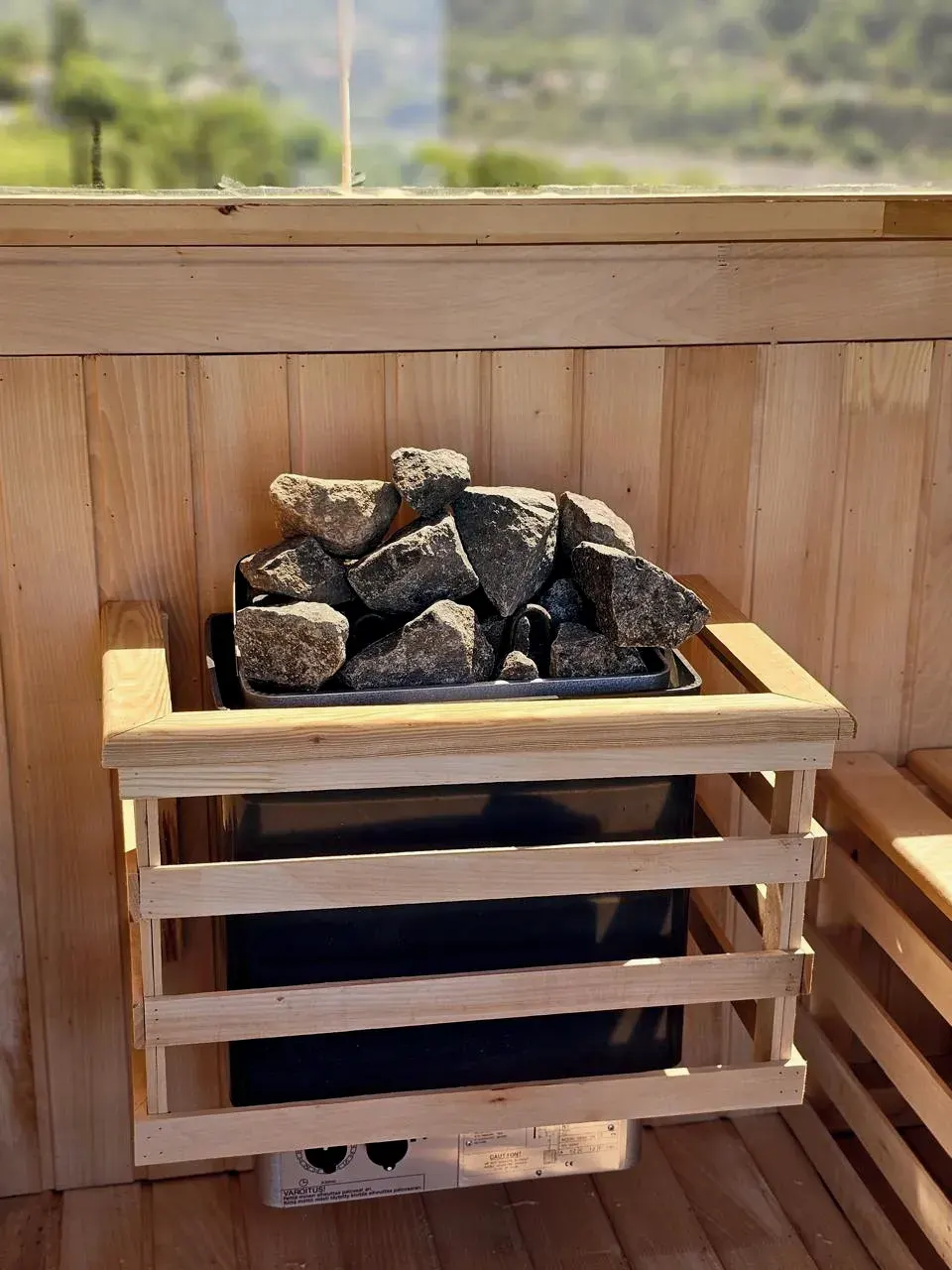
- Stack stones loosely, not tightly, so air can flow between them. In an electric heater the elements must be fully covered but never wedged in.
- Check the stones at least once a year and replace any that have crumbled or cracked.
Control panels: what to know
Electric heaters come with two types of control:
- Built-in controls — buttons or dials on the heater itself. Simple and reliable for small saunas.
- Separate control panel — mounted on the wall outside the sauna room. You set temperature, timer and sometimes lighting from one place. Some models allow pre-set start times or app control.
Electrical requirements: larger heaters typically need a three-phase supply (380–400 V). Cable size, breaker and earthing must be checked by a qualified electrician.
Safety rules
- Respect clearances. The manufacturer specifies minimum distances from the heater to wooden walls, ceiling and benches.
- Install a heater guard — a wooden rail around the stove prevents accidental burns.
- Mount the temperature sensor of an electric heater exactly as the manual says; the wrong spot can cause overheating.
- A wood-burning chimney must be insulated, with a fire-safe pass-through at the ceiling and roof. Clean it regularly.
- Ventilation with fresh-air intake and exhaust matters for comfort and safety.
- Never dry towels or clothes on the heater.
Harvia, SAWO, Teplodar, TMF and Fanlan: the brands we install
We sell and install heaters and accessories from Harvia, SAWO, Teplodar, TMF and Fanlan. Harvia and SAWO are well-known Finnish sauna heater brands offering both wood-burning and electric models.
We don’t pick a heater off a shelf — we match it to your specific sauna: its volume, wall materials, glass area and the way you plan to use it. Browse models in our heaters section, and stones, buckets, ladles and thermometers under accessories.
Which heater is right for you? A quick checklist
- Sauna inside the house → electric heater.
- Sauna in the garden, chimney possible, you want a real fire → wood-burning heater.
- Weak electrical supply → wood-burning heater, or upgrade the supply.
- Daily use, hotel or spa → electric heater with a separate control panel.
- Cabin sauna with a panoramic glass front → size the heater with the glass area in mind.
FAQ
How do I calculate the right sauna heater size?
Work out the room volume (width × length × height) and allow about 1 kW per 1 m³. For every 1 m² of uninsulated surface such as glass, stone or tile, add about 1.2 m³ to the volume. Then confirm with the manufacturer’s sizing table.
Is a wood-burning or electric sauna heater better?
There’s no universal answer. Wood-burning gives a traditional atmosphere and independence from the grid; electric gives convenience, precise temperature and no chimney. Indoor saunas usually go electric, while outdoor saunas work well with either.
How often should sauna stones be replaced?
Inspect and restack them at least once a year, more often with heavy use. Replace crumbled or cracked stones — they block airflow and can shorten the heater’s life.
Does an electric sauna heater need three-phase power?
Some lower-output heaters run on single-phase, but larger models usually require three-phase. The heater’s manual and a qualified electrician should decide.
Can I swap the heater later?
Yes, as long as the new heater fits the room in size, output and safety clearances. Switching from wood-burning to electric may require preparing a new electrical circuit.
Not sure which heater suits your sauna? Send us the room dimensions and what you’re looking for — we’ll give you a free consultation and recommend the right option. Message us on WhatsApp.